
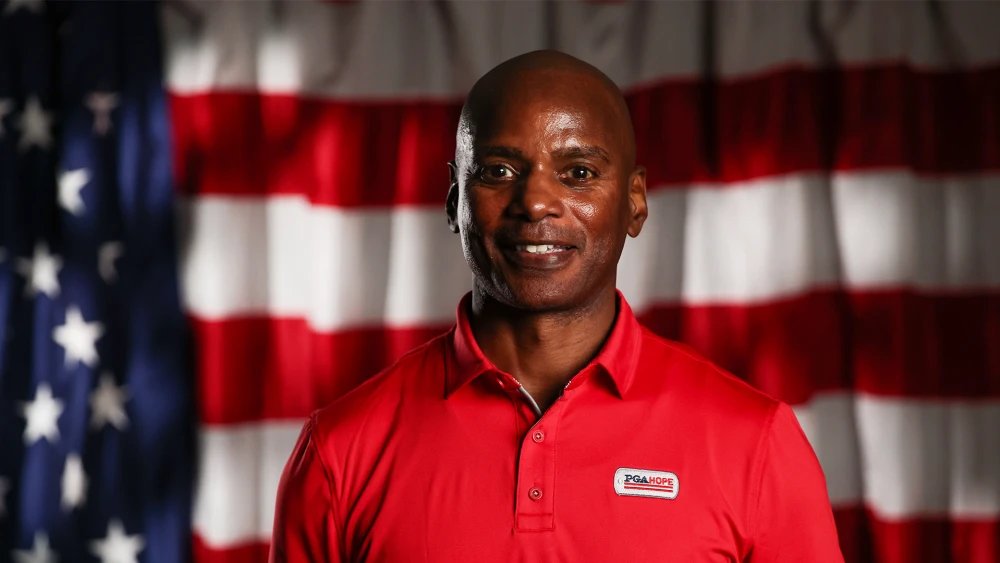
For much of his life, Truman Small Jr. had been searching for a place where he belonged.
He had looked for it in the military, where he excelled as a young soldier despite the personal struggles that eventually ended his Army career. He had looked for it in the fire service, where he built a nearly three-decade career, half of which was performed while privately battling addiction. And he had spent years trying to find it within himself, working to overcome the painful messages he had absorbed during a difficult childhood.
Then, 17 months ago, at age 53, he picked up a golf club for the first time.
Through PGA HOPE, the PGA of America REACH Foundation’s flagship military program that introduces and teaches golf to Veterans and Active Service members, Small discovered a community that welcomed him without judgment, without expectations and without expecting him to be anyone other than himself.
For someone who had spent decades questioning his worth, that’s all he needed.
“I like golf,” he said. “I love PGA HOPE more.”
Small grew up in Bridgeport, Connecticut, the middle child in a family of five children. There wasn’t much money. His family relied on public assistance, and his home life was marked by instability and abuse, both mental and physical. He points to a scar on his head to show proof.
His biological father wasn’t present. He never felt connected to his stepfather.
Despite everything that was happening at home, Small was an excellent student, graduating from junior high as salutatorian. He enrolled in a vocational high school, where he studied plumbing while continuing his academic work.
But his teenage years took a difficult turn.
He began drinking, getting into trouble and making decisions that eventually led to his expulsion from school. After his mother forced him to move out of their home before his 16th birthday, he stayed with friends, relatives and anyone willing to give him a place to sleep.
He knew the direction his life was heading.
“I didn’t want to go to jail,” he said. “And I didn’t want to be homeless.”

In 1989, at 17, Small enlisted in the Army National Guard. It wasn’t a decision driven by patriotic ambition or a lifelong dream of military service.
“The military was the only other option where I could be on my own,” he said. “I had no idea what the military was.”
The discipline, structure and expectations that intimidated some recruits came naturally to him. He became a squad leader during training and experienced a sense of accomplishment that had been largely absent from his childhood.
For the first time, he felt special.
When he returned to Connecticut after his initial training, however, that feeling disappeared. Civilian life offered little direction, and he found himself working in telemarketing.
So, in February 1990, Small joined the Army. Within months, he was headed to war. In October, he deployed to the Middle East during the Gulf War, serving through Operations Desert Shield, Desert Storm and the recovery period that followed.
As a tank driver, he experienced the uncertainty and danger of combat. He remembers hearing rounds striking the outside of his tank and realizing how much protection the armored vehicle provided. He also remembers learning that another tank in his battalion had struck a landmine.
“It was pretty hairy,” he recalled.
Yet even as Small performed his military responsibilities, another struggle was intensifying. His drinking, which began during adolescence, continued throughout his service. He could succeed professionally while simultaneously making choices that threatened everything he had accomplished.
“I was participating in the world,” he said. “But imagine what I could have done if I wasn’t drinking.”
Aside from the Middle East, his Army career included assignments in South Korea, Texas, Georgia and Japan. He earned promotions, received recognition and worked in logistics, eventually holding a position involving sensitive military operations.

But repeated alcohol-related disciplinary problems followed him. He was reduced in rank more than once. His career prospects narrowed, and in September 1997, after eight years of service, he left the Army with an honorable discharge. Small returned to Connecticut without a clear plan. Less than a year later, on Aug. 3, 1998, he joined the Stamford Fire Department. It was another opportunity to build a meaningful career.
For the next 12 years, however, Small’s drinking and substance use increasingly dominated his life. He continued working as a firefighter, but he acknowledges that he wasn’t always performing his job as he should have been. His personal life deteriorated. Relationships ended. He isolated himself and struggled to maintain his home.
From the outside, he could present himself as a capable fire fighter. Behind that appearance, his life had become increasingly difficult to manage.
“When I tell my story, there’s no shame in it,” Small said. “This is a part of me.”
By September 2010, Small knew something had to change.
On September 13, he sought emergency help through his employer’s assistance program. That decision led to treatment, including a 28-day residential rehabilitation program at Stonington Institute in Connecticut, followed by months of intensive outpatient care.
He has not consumed alcohol since.
“I never liked drinking,” Small said. “I never liked doing drugs. I never liked being me, either.”
Recovery required him to confront the feelings he had spent years trying to escape. It also opened doors he never imagined. In 2011, Small returned to school. He earned an associate degree, continued his education at the University of Connecticut and received a bachelor’s degree in psychology. He later pursued graduate studies in clinical social work, stopping one semester short of completing his master’s degree.
His interest in human behavior wasn’t merely academic. He wanted to understand himself and, perhaps, help other Veterans navigate difficulties of their own.
Meanwhile, his career in the fire service continued.

Today, at age 55, after 28 years with the Stamford Fire Department, he serves in a trusted position as an aide to the deputy chief, assisting with fireground operations and administrative responsibilities. He has rebuilt much of his life. But rebuilding confidence still proved complicated. Even after years of sobriety and job stability, Small struggled with isolation.
He found it difficult to trust others. He often kept his distance socially, uncertain whether people genuinely wanted him around. While receiving counseling at a Veterans center, he was encouraged to consider PGA HOPE (Helping Our Patriots Everywhere). The timing seemed right, so Small enrolled in a session at Goodwin Park Golf Course in Hartford, Connecticut, in May 2025.
It was the first time he had ever held a golf club.
He graduated from the program in June.
I found a place where I could come in, and they didn’t know me, and I could just kind of be me.
There were no expectations based on his military record, his past struggles or his professional position. He was simply another Veteran learning something new. And he wanted to keep coming back.
After graduating, Small began attending subsequent PGA HOPE sessions. Not to receive more instruction, but to help. He set up tents, collected golf balls, carried equipment and talked with other Veterans.
He also developed a particularly meaningful relationship with Dennis Dungee, the executive director of the Connecticut PGA Section.
“He was one of the first ones who showed up asking if we needed help,” Dungee recalls. “He was very energized to be there for sure. He brought life to the party”.
“He’s very attentive, asks the right questions. He’s listening to learn, whether that’s golf related, or just trying to get to know you personally. Veterans and coaches both really appreciated that.”

When Small was selected to participate in the PGA HOPE’s Ambassador experience – which includes National Golf & Wellness Week in Washington, D.C., this week and time at Congressional Country Club – his immediate reaction wasn’t pride. It was disbelief.
“I still don’t know why Dennis chose me for this,” he said.
That response revealed just how much work remains beneath the surface.
For Small, being a PGA HOPE Ambassador has been both rewarding and emotionally demanding.
During a recent gathering with other Veterans, he listened as participants shared deeply personal experiences involving family, military service and the difficulties of returning to civilian life.
One Veteran’s discussion of family relationships reminded him of his own childhood. Another conversation brought back feelings he had spent years trying to put behind him.
At times, the emotions became overwhelming. But something different happened this time. Rather than withdrawing completely, he allowed other Veterans to support him.
“He brings an organic positivity that is unlike anybody else’s,” said Dusty Hull, Small’s Squad Leader for their Havoc team this week at Congressional. “All of the things that he’s bringing are unlike anyone else. They’re organic, they’re authentic, and they’re on a level that’s not traditional. And it just means that much more.

“I mean, from a Squad Leader perspective, we’re supposed to be pushing the team to enjoy this moment, to enjoy the training, take the training, and be able to go forth and spread the word where they’re coming from. And he is helping me learn how to go forth, spread the word, and enjoy the game more. He’s almost as much of a leader to me as I am trying to be to him.”
Yet Small still doesn’t see it that way.
“I don’t think I’m good enough,” he said. “And I don’t think I belong in environments that I’m presently in now.”
For someone who survived a turbulent childhood, served in combat, overcame addiction, returned to college and built a long career in public service, those feelings might seem difficult to understand but he still carries years and years of deeply rooted doubts.
Golf and PGA HOPE have given Small a new activity to enjoy, but its greatest contribution has been the relationships he’s forged.
He has connected with Veterans whose experiences differ from his own but whose struggles sometimes feel remarkably familiar. He has found people who listen without judging. And he has discovered opportunities to give something back.
That’s what motivates Small to continue attending sessions long after completing his own. He wants to be available when another Veteran needs someone to talk to, someone to listen to or simply someone to make them feel welcome. At the same time, Small recognizes that helping others requires him to care for himself.
There are still difficult memories to process and relationships to understand. But now he has a community willing to walk alongside him.
“I’m going to try to be where my feet are, and enjoy the people, and enjoy the moment, and trust myself,” he said. “It’s a journey, not a destination.”
The man who joined the military because he had nowhere else to go has finally found a place where he feels welcome. Not because of his rank, his career, his education or his golf swing. Simply because he’s Truman Small Jr.
And that’s more than enough.
PGA HOPE (Helping Our Patriots Everywhere) is on a mission unlike any other – to change and save Veteran’s lives through the power of golf. The program introduces and teaches golf to Veterans and Active Service Members to enhance their physical, mental, social and emotional well-being. Led by PGA of America Golf Professionals, the program is inclusive of a developmental 6-8 week curriculum. All programs are provided at no cost to all participating Veterans. To learn more or donate, visit www.pgahope.com.
