
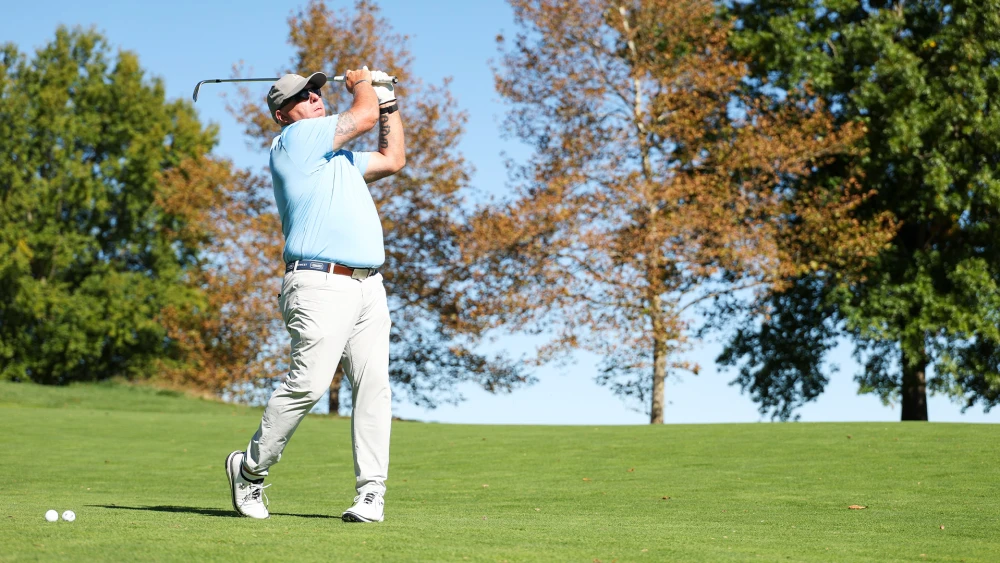
David Curry had spent most of his adult life serving his country, raising a family and overcoming obstacles that, at times, seemed insurmountable. But he was never quite able to figure out his relationship with his father.
The two weren’t estranged. They weren’t necessarily at odds. They simply weren’t close.
His father, Dave, was a retired truck driver and Army Veteran who, like his son, had settled into a sedentary lifestyle. Their conversations were occasional, their shared activities limited.
Then David discovered golf. And, eventually, PGA HOPE, the PGA of America REACH Foundation’s flagship military program that introduces and teaches golf to Veterans and active service members.
What started as a personal journey into a game he once considered boring became something much bigger. Curry introduced his father to the program, and the two began spending time together on the golf course. Now they play almost every week.
“We’re in the best relationship we’ve had our entire lives,” David Curry said. “It’s all because of HOPE.”
It’s an extraordinary development for a 47-year-old Army Veteran who, just a few years earlier, had little interest in golf and was struggling to find direction after leaving the military. Curry grew up in Prairie Village, Kansas, in a working-class family. His parents struggled with substance abuse during his childhood.
“I’ve never even tried drugs,” he said. “I saw the negative consequences of that.”
His parents eventually achieved sobriety, and Curry remembers much of his childhood fondly. After high school, he attended the University of Kansas, joined Sigma Alpha Epsilon fraternity and participated in Army ROTC. He hoped to become an officer, but after being dismissed from the program, he took a different route.

He enlisted in the Army Reserve in 2000 as a Civil Affairs Specialist. In 2003, he transferred to the Kansas Army National Guard and reclassified into the infantry. Two years later, he deployed to Iraq. He was 25, newly married and about to become a father.
Curry’s first deployment, to Baghdad during Operation Iraqi Freedom in 2005-06, was the most difficult of his three overseas assignments. Serving as a .50-caliber machine gunner, he participated in hundreds of patrols, convoy escorts and security operations during a particularly dangerous period of the Iraq War. The physical danger was constant. So was the uncertainty about what awaited him at home. His wife was pregnant when he deployed, and Curry returned briefly for the birth of his son.
When he returned four good months later, he was greeted by a baby who didn’t recognize him, a troubled marriage and a mother battling advanced cancer. Rather than taking time to decompress, Curry returned to civilian employment two weeks later. As a National Guardsman, he didn’t have the familiar military structure that active soldiers often return to after deployment.
“How the hell do I go from that to working in an office for eight hours?” he remembered wondering. He acknowledges that he didn’t take post-deployment mental health assessments and transition resources seriously enough. He wishes he had sought help sooner.
Curry’s mother died in August 2007. A year later was the beginning of what he calls “rock bottom.”
He lost his job and his family’s finances collapsed. They lost their home to foreclosure and relied on public assistance. His marriage continued to deteriorate.
“Everything’s against you,” he said. “You’re swimming upstream.”
In 2010, Curry deployed again, this time to the Horn of Africa, supporting operations in Djibouti and Ethiopia. During that deployment, he began seeing a military family life counselor, addressing the emotional challenges he had carried since Iraq.
“It was a breath of fresh air,” Curry said.

He continued counseling after returning to Kansas in 2011 and made significant changes to his life. He separated from his first wife and moved into a place of his own, where he had little more than a television and a bed. He wanted to provide stability for his children, rebuild his career and create a healthier future. He pursued professional opportunities and gradually regained financial security.
Curry also met Sarrisa, the woman who would become his second wife. They married in 2015, blending their families and building a partnership Curry credits with helping him become the person he is today. When he deployed for a third time in 2018-19, supporting Operation Spartan Shield, the experience was markedly different. His wife provided stability at home, allowing him to concentrate on his military responsibilities.
“I will 100 percent attribute a lot of my success to my wife,” he said.
By then, Curry had established a successful civilian career in information security. Today, he works as a customer success executive for Cisco Systems. In 2020, after 20 years of military service, he retired from the Army as a sergeant. But another challenge emerged. Curry’s retirement coincided with the COVID-19 pandemic. There was no traditional farewell celebration or meaningful gathering with fellow soldiers to acknowledge two decades of service. He simply transitioned out. It was unsettling for a man who had spent 20 years identifying as a soldier.
“You’ll miss the clowns, but you won’t miss the circus,” he said, repeating a familiar military saying.
Although his professional and family lives were stable, Curry became less active and increasingly disconnected from his social circles. His physical health suffered, he approached 300 pounds and developed health concerns, including high blood pressure and prediabetes. He began working on his fitness and nutrition – losing close to 80 pounds. Then something unexpected caught his attention.
Curry had always dismissed golf as an old man’s game. He never understood the attraction. But after watching the Netflix series “Full Swing,” he became intrigued. Within days, he had watched the entire season. He wanted to give the game a shot. A friend gave him a set of clubs, and Curry headed to the practice range. He struggled. He hit terrible shots. And he loved every minute. Soon he was invited to a scramble tournament, where he estimates he lost a dozen golf balls. He was hooked. Golf offered something he hadn’t realized he was missing – a challenge, a purpose, a reason to get outside and connect with others.
“Golf is life, and life is golf,” he said.
Eventually, Curry learned about PGA HOPE (Helping Our Patriots Everywhere). He enrolled at St. Andrews Golf Club in Overland Park in 2024, appreciating the structured instruction, welcoming environment and instructor’s willingness to work with Veterans of different backgrounds and abilities. But what resonated most was the community. After completing the program, Curry told local PGA HOPE leadership that he wanted to help. He began volunteering, organizing events, supporting fundraising efforts and encouraging other Veterans to participate. He also helped establish a communication network so graduates could stay connected.
“I was struck by a number of things,” said Deb Richard, the PGA REACH Midwest Section PGA Foundation Director. “He’s very grounded, very clear in what he wants to have himself and other Veterans get out of PGA HOPE. His approachability makes it very easy for Veterans to get to know him. He becomes a confidant. Unquestionably his passion is there for the program. It gave him purpose.”
Curry’s involvement led to him being nominated as a PGA HOPE Ambassador for the Midwest PGA Section, which included participation in National Golf and Wellness Week in Washington, D.C., and time at Congressional Country Club with 19 other Ambassadors.
“It’s been about four months since we first connected,” said Jason Strejcek, Curry’s Squad Leader in Washington for their Section 8 Squad. “First call, he was just making jokes and really making everybody feel comfortable. He can be serious, but he can also be absolutely hilarious. He is just absolutely a wonderful human being.”

But Curry’s most meaningful contribution happened closer to home when he introduced his father to PGA HOPE. After retiring from truck driving, Dave Curry wasn’t particularly active. His health had become a concern, and he wasn’t doing much socially. David recognized the familiar patterns and suggested that his father try the program.
“I saw that flicker of light in him again,” David Curry said of his father. “That same flicker in me, that ignition spark.”
His father began practicing and playing regularly. He started going to the gym, paying closer attention to his health and spending more time with his son. The two began playing almost every week. Their once-distant relationship developed into a genuine friendship. Golf gave them something to talk about, something to work toward and, most importantly, something to share. Dave also became involved in PGA HOPE, helping other participants, giving away clubs and volunteering at a local course. Like his son, he discovered that golf could be a way to serve others. And he found new motivation to take care of himself.
Their enthusiasm has even created the possibility of another family connection. David’s 20-year-old son, Ciaran, is serving in the National Guard while pursuing an Army commission. David hopes to introduce him to PGA HOPE, potentially creating three generations of family participation.
“If that happens, I know he would be the proudest papa on the planet,” Deb Richard said.

Today, David Curry plays to a 19 handicap and has embraced golf with the enthusiasm of someone determined to make up for lost time. In just a few years, he has played more than 115 courses across eight states, visited famous golf destinations and discovered a community extending far beyond his local PGA HOPE chapter. He volunteers at his wife’s nonprofit, the Parkinson’s Exercise and Wellness Center, and has become an advocate for Veterans’ mental health, emphasizing the importance of counseling, connection and having people to turn to during difficult times. Curry knows personal struggles don’t disappear. He still has difficult days. But he’s learned that asking for help is not a weakness.
“Service members are always looking for a tribe,” he said. “We need a group. We need a mission.”
For Curry, PGA HOPE has become that mission. He wants to help Veterans discover the same sense of purpose and connection that changed his life. And he wants to keep sharing the game with his father.
Curry often thinks about a phrase he heard during a PGA HOPE gathering: The most important shot in golf is the next one. After 20 years in the military, three deployments, personal setbacks and a difficult transition to civilian life, he understands that he cannot change the past. But he can decide what happens next.
“The next move is the most important,” Curry said. “The next decision, the next day.”
A day that now often includes a round of golf with his dad.
PGA HOPE (Helping Our Patriots Everywhere) is on a mission unlike any other – to change and save Veteran’s lives through the power of golf. The program introduces and teaches golf to Veterans and Active Service Members to enhance their physical, mental, social and emotional well-being. Led by PGA of America Golf Professionals, the program is inclusive of a developmental 6-8 week curriculum. All programs are provided at no cost to all participating Veterans. To learn more or donate, visit www.pgahope.com.
